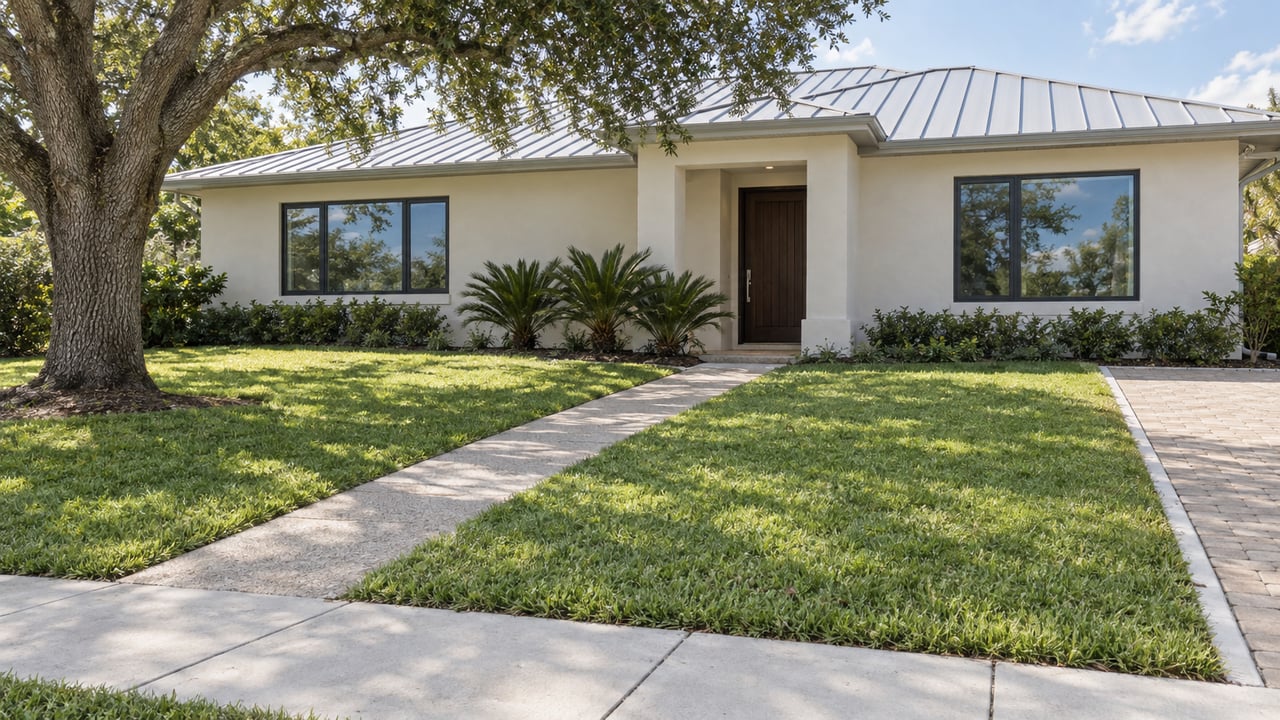
Poinsettia Park's Streetlights Are Getting an Upgrade. The Bill Hasn't Been Written Yet.
"If you ask 1,000 people would you like the city to bury your power lines, 1,000 people would say yes." St. Armands Residents Association president Chris Goglia said that to the Sarasota City Commission this year, and he finished the thought with the part that matters more: tell those same 1,000 people they'll need a metal box on their lawn and a bill to match, and the yeses get quieter fast.
Goglia was talking about undergrounding power lines on St. Armands and Lido Key. But the same arithmetic is running quietly through South Poinsettia Park, the historic pocket of Sarasota locals call the Flower Streets, where the city has spent the past year building the financial plumbing to pay for new street lighting. Nobody has been handed a bill yet. The city just spent February clearing the specific legal path that would let one arrive.
For anyone comparing a listing on Magnolia or Goldenrod against a comparable house three blocks over, that distinction is the whole story. The mechanism the city chose doesn't touch the sale price, doesn't show up in a standard tax history pull, and won't appear on a title search until the city decides it should. It shows up on the tax bill, later, as a separate line with its own math.
South Poinsettia Park has been asking the city for better street lighting since at least mid-2025, when its neighborhood association pitched a plan to replace the neighborhood's original wooden poles with modern, "antique style" fixtures, citing Department of Transportation Safe Routes to School standards and the city's own complete streets principles. On October 20, 2025, the Sarasota City Commission voted unanimously to start building the legal framework for a special assessment district to fund it, according to the Sarasota Observer. A resident survey backing the request showed 70 percent support within South Poinsettia Park.
Then, on February 17, 2026, the commission approved the specific financing tool: the city will use non-ad-valorem billing for any future lighting district in the neighborhood. According to the neighborhood association's own account of that meeting, the vote does exactly one thing. It gives the county tax assessor a mechanism to add a line to future tax bills if a district is eventually formed. It does not commit the city or any resident to a dollar figure, a start date, or even a final yes. An engineering firm was under contract by that same February, with cost estimates still to come.
That is where the process sits today. The runway is built. The plane hasn't been priced.
The word doing the quiet work here is non-ad-valorem. Sarasota County's property appraiser explains the distinction plainly: ad valorem taxes are based on what your property is worth, while non-ad-valorem assessments are based on a unit the levying authority sets itself, unrelated to value. Fire and rescue fees, solid waste collection, and stormwater charges all work this way already in Sarasota County. Some of these assessments appear on the annual TRIM notice every property owner receives in August. Others don't, and the county's own guidance notes that additional non-ad-valorem charges can simply appear on a tax bill outside that notice.
For a buyer, the practical effect is that a future South Poinsettia Park lighting assessment would not show up in a seller's current tax bill, because it doesn't exist yet as a billed item. It would not show up in three years of comparable sales data, because none of those homes have paid it either. It would show up the year the district is finalized and billing begins, whenever that turns out to be, as a new number on a bill that otherwise looks familiar.
Because South Poinsettia Park's own costs aren't set, the only way to size this is to look at what the same financing tool costs elsewhere in Sarasota right now. The city is running an almost identical process, at a much larger scale, a few miles away on the barrier islands, and that project has real numbers attached to it.
| District | Project | Status as of September 2026 | Cost per property |
|---|---|---|---|
| Longboat Key | Full utility undergrounding | Completed after nearly a decade | About $4,200 over 30 years |
| St. Armands / Lido Key | Utility undergrounding | Consultant hired July 2026; parcel-level estimates expected winter 2026-27 | Potentially up to $10,000 over 20 years |
| South Poinsettia Park | Street lighting upgrade | Non-ad-valorem billing method approved February 2026; engineering underway | Not yet estimated |
The scope isn't comparable. Burying power lines on a storm-exposed barrier island is a different order of project than replacing streetlight poles in an inland historic neighborhood, and the motivations differ too. St. Armands and Lido Key are chasing storm resiliency after outages that Sarasota Public Works Director Nikesh Patel told commissioners lasted roughly a week to a month following the 2024 hurricane season. South Poinsettia Park is chasing pedestrian safety standards on streets its own neighborhood association says haven't kept pace with current design guidelines.
What the two projects share is the funding instrument. Both run through a city-created special assessment district billed as a non-ad-valorem charge, and both required the same procedural sequence: a resident survey, a commission vote authorizing staff to build the framework, an engineering and cost-estimate phase, and only then a vote on the actual assessment. The barrier islands are roughly a year ahead of Poinsettia Park in that sequence. Their numbers, while explicitly preliminary, are the closest real precedent a Flower Streets buyer has for what this kind of district tends to cost once it's priced.
South Poinsettia Park is a compact, clearly bounded neighborhood: 19 streets between Hyde Park Street to the north and Jasmine Drive to the south, running from Tamiami Trail on the east to Osprey Avenue on the west, with roughly 380 residences and about 50 businesses inside its borders. It celebrated its centennial in March 2025, and its housing stock reflects that span, from 1920s Mediterranean and Mission Revival homes built by Logan & Currin around the De Sota Park sub-district to mid-century ranches and newer custom builds along the same tree-lined blocks.
The neighborhood association has already shown it can move city infrastructure projects forward on a similar track. Clematis and Wisteria streets were selected for repaving and new curbing through the same kind of ongoing coordination with the city that's now handling the lighting proposal. That track record is useful context. It suggests the lighting district is a matter of when the numbers get finalized, not whether the city takes the request seriously, though nothing in Public Works Director Patel's public comments on the barrier island project suggests any of these processes move quickly. He told commissioners the St. Armands and Lido Key undergrounding alone would take three to four years to implement and up to seven years to fully complete, and that project is already a year further along than South Poinsettia Park's.
A pending or possible special assessment district is not a lien, and it's not a reason to avoid a neighborhood that residents have spent a century maintaining as one of Sarasota's more walkable historic pockets. It is a reason to ask a specific question before writing an offer rather than after closing.
Start by asking whether the seller or listing agent has any knowledge of the South Poinsettia Park street lighting proposal and its current status. The neighborhood association publishes its own timeline and updates, which is the most current public source for exactly where the process stands. Ask specifically whether cost estimates have been released, since that's the point at which a vague future line item becomes a real number tied to a specific parcel.
It's also worth understanding that the process gives residents a voice before any bill is finalized. The barrier island precedent shows the city gathering resident support at multiple stages, first through informal surveys, later through what the county's process describes as a resolution requiring public notice for four consecutive weeks before tax bill collection can begin. South Poinsettia Park will likely follow a similar sequence, which means a buyer today isn't walking into a bill. They're walking into a neighborhood mid-process, with a City Commission that has shown it will move deliberately rather than quickly on the mechanism.
Is the street lighting assessment already on anyone's tax bill? No. As of the February 2026 commission vote, the city has only approved the billing method it would use if a district is ever finalized. No costs have been assessed to any property.
How is this different from an HOA fee or a CDD bond? A non-ad-valorem special assessment is created and billed by the city or county rather than a homeowners association or community development district, and it's tied to a specific municipal project rather than ongoing community amenities.
Does the city require majority resident support before creating the district? Not by law. Sarasota's public works director has told commissioners that neither state statute nor city ordinance sets a minimum support threshold, though the commission has so far relied on resident surveys and votes as a practical gauge before proceeding.
Where can I check the current status myself? The South Poinsettia Park Neighborhood Association publishes ongoing updates on its street lighting page, and the Sarasota Observer has covered each commission vote as it happens.
If you're weighing a Flower Streets address and want to know exactly where this process stands before you write an offer, Kelly Pankiw tracks Sarasota's special assessment districts the same way she tracks comps. Let's Connect and walk through what a Poinsettia Park purchase actually costs, this year and down the road.
With over 20 years of marketing and sales expertise, Kelly Pankiw delivers a refined real estate experience built on integrity, market knowledge, and exceptional client care. From first-time buyers to luxury home sellers, she combines local insight with global marketing power to help clients achieve their real estate goals with confidence.
871 VENETIA BAY BLVD. STE 237 VENICE, FL 34285